Investing in Sovereignty, Interview with Erin Hallock, NATO Innovation Fund
.avif)
%20(3).webp)


The world’s first multi-sovereign VC fund is primed to tap into the global deeptech boom.
The NATO Innovation Fund (NIF), a €1 billion multi-sovereign fund supported by 24 Allied countries, was announced in June 2022 with the aim of investing over a period of 15 years into promising deeptech startups that can address capability gaps in defence, security and resilience across NATO nations.

Since Russia’s attack on Ukraine in 2022, defence and sovereignty have been reverberating themes in Europe’s investment landscape. These are sectors that are gaining traction fast; in 2025, investors poured a record $8.7 billion into European deeptech startups, per Dealroom data.
“The NIF is compelling and interesting because in the current environment, there isn’t a more relevant fund with that investment thesis,” Erin Hallock, partner at the NIF, told European Women in VC in an interview.
“The idea of closing the capability gaps and accelerating the adoption of deeptech breakthrough innovations is no longer something that can afford to be aspirational for Europe — it’s a necessity for the security, wellbeing, and economies of the billion citizens within the NATO alliance,” she added.
Closing Europe’s deeptech gap
Unlike many of its counterparts in Europe’s venture ecosystem, the NIF is committed to providing patient capital over the course of at least 15 years. This offers companies an opportunity to finetune their research instead of prioritising quicker returns — a boon for founders working within more technical sectors encompassing hardware or novel technologies.
About 80% of the NIF’s capital is plugged directly into startups, while around 20% is pumped into funds.
The direct portfolio targets startups from seed to Series B, with initial cheques of €1 to €15 million, with substantial reserves for subsequent rounds.. The fund is also flexible with leading and co-leading its rounds. To date, it’s made 19 direct investments, with “autonomy” and sovereignty-adjacent sectors comprising roughly a third of its portfolio. It counts the likes of Fractile, Isar Aerospace, and ARX Robotics among its portfolio.
“The fund of fund investment thesis is primarily about backing managers in frontier or more nascent markets; so where you see VC is relatively new, it’s about backing those green shoots,” she said. “We often find ourselves in those markets backing first time managers and teams in a bid to seed the ecosystem,” and has backed funds including Twin Track VC (led by a solo female GP), Expeditions and BSV Ventures. The fund is also keen to back managers with sector-specific theses, in more niche areas — such as space and quantum.
Cashing on the defence boom
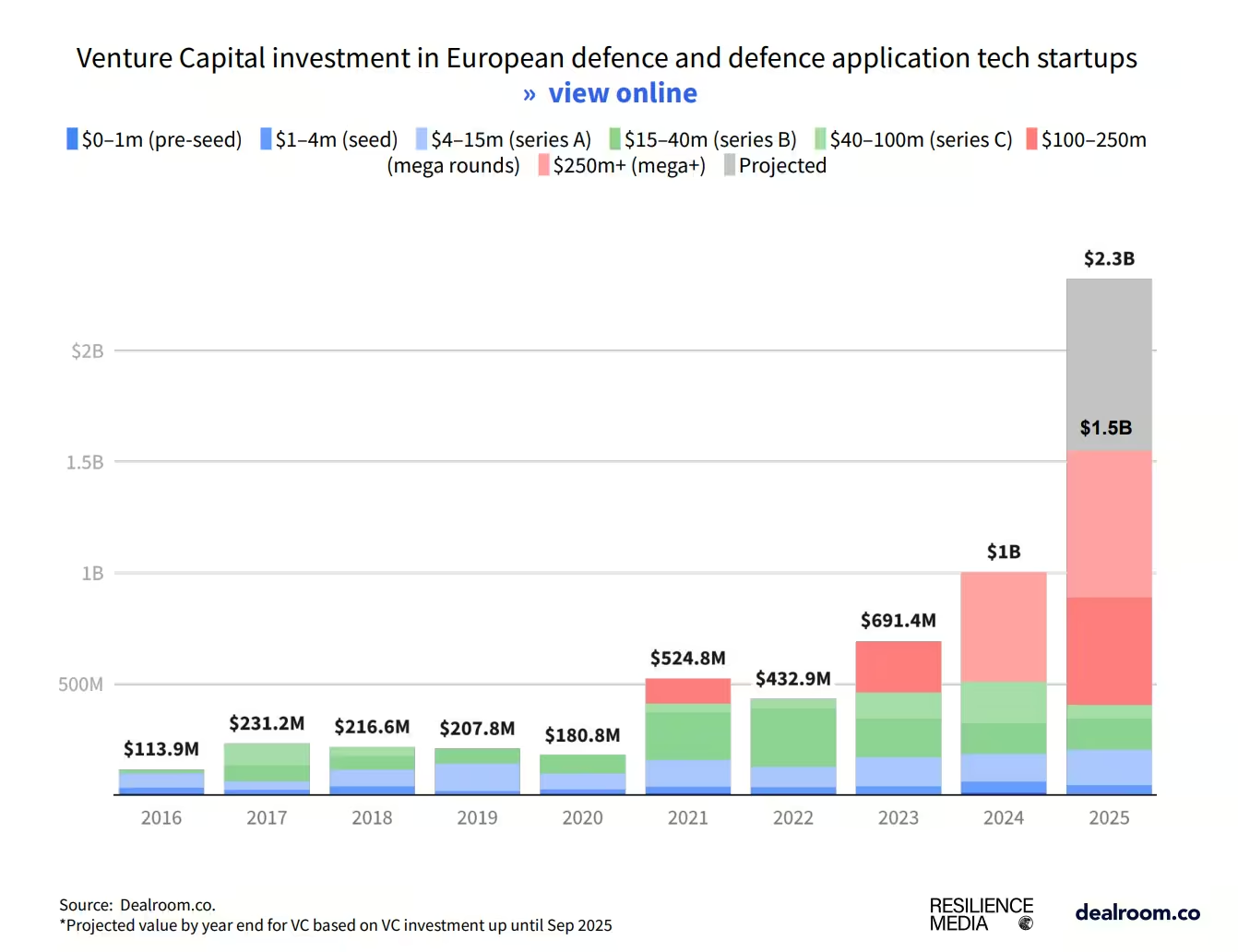
2025 was a banner year for VC funding into defence tech in Europe, with startups clinching over $1.5 billion in funding in the first three quarters of the year — far eclipsing the $1 billion raised in 2024 alone.
The NIF is capitalising on this fervour. Hallock notes that a unique benefit of the fund is that it can work very closely with NATO and the Ministries of Defence for the 24 LPs. “We get very strong demand signals in defence, and it’s a unique market because there are a limited number of customers on that market so they need to understand their capability gaps,” she added.
To bridge this, the NIF has a dedicated team that works with its portfolio companies to help them perform in front of the buyer community and demonstrate their technology in a simulated context.
Case in point, Hallock points to the likes of Kraken, an autonomous surface vessels startup, as one of its portfolio standouts. “These are driverless boats, principally for defence use. Prior to making this investment, we worked with NATO to understand where there were capability gaps. The investment team curated a thesis around that, and mapped the market to try and understand where the key players and opportunities were.”
While sovereignty has been a buzzword in the investment ecosystem in the past few years, Hallock sees this as a fruitful opportunity for the fund in more than one way.
“What is really important is that we rebuild a lot of the capabilities we’ve offshored in the last handful of decades — and we would be remiss to not back European startups.”
The NIF co-invests with a global cohort of investors in a bid to broaden its investment horizons, and ultimately operates independently of NATO.
“It’s about commercialising the IP and tech that comes out of Europe’s leading universities,” she noted. “So it’s not necessarily about Europe for Europe, but making sure that these businesses that originate in Europe don’t redomicile elsewhere because they can’t raise capital.”
Indeed, one of the biggest challenges for European startups has been how capital stymies at the Series C stage. European investors get uncomfortable at a high cash burn, and they need to move away from building around arbitrary financial KPIs and build for growth, Hallock said. “Because we’re a long-term investor, we bring a cohort of customers right behind our capital — so we can help address that,” she added.
Erin Hallock joined the NATO Innovation Fund after a stint at BP Ventures, where she led the full investment lifecycle in digital technologies, deep tech, and exploratory ventures as a Managing Partner.
The NATO Innovation Fund is a €1 billion venture capital fund, backed by 24 NATO Allies, that invests in deep tech to address challenges in defence, security, and resilience. The fund invests independently with 24 nations supporting its portfolio’s success and helping provide deep tech entrepreneurs with access to both commercial and government markets.