Iceland Innovation Engine, Interview with Hrönn Greipsdottir, New Venture Fund Kria

%20(3).webp)


Iceland is renowned for its picturesque vistas, marked by active volcanoes and majestic glaciers. Now, the Land of Fire and Ice is making a name for itself beyond its natural wonders - by embracing new ventures and technology.
Home to a population of just over 400,000, the country has fostered an intimate business ecosystem that prioritises collaboration over competition. “Although we’re an island, we’re between Europe and the US. We put an emphasis on being a part of these international associations,” Hronn Greipsdóttir, CEO of Iceland’s New Venture Fund Kria, told European Women in VC in an interview.
Kría Venture fund is a newly established state fund, a result of the merger between two major Icelandic funds, the Icelandic New Business Venture Fund and Kria fund of funds, embodies the country’s appetite to grow its technology ecosystem. In a bid to marry together the strengths of these individual funds, Kría venture fund will double down on two main investment categories - both longer-term, patient capital into funds as well as direct investments in early-stage startups.
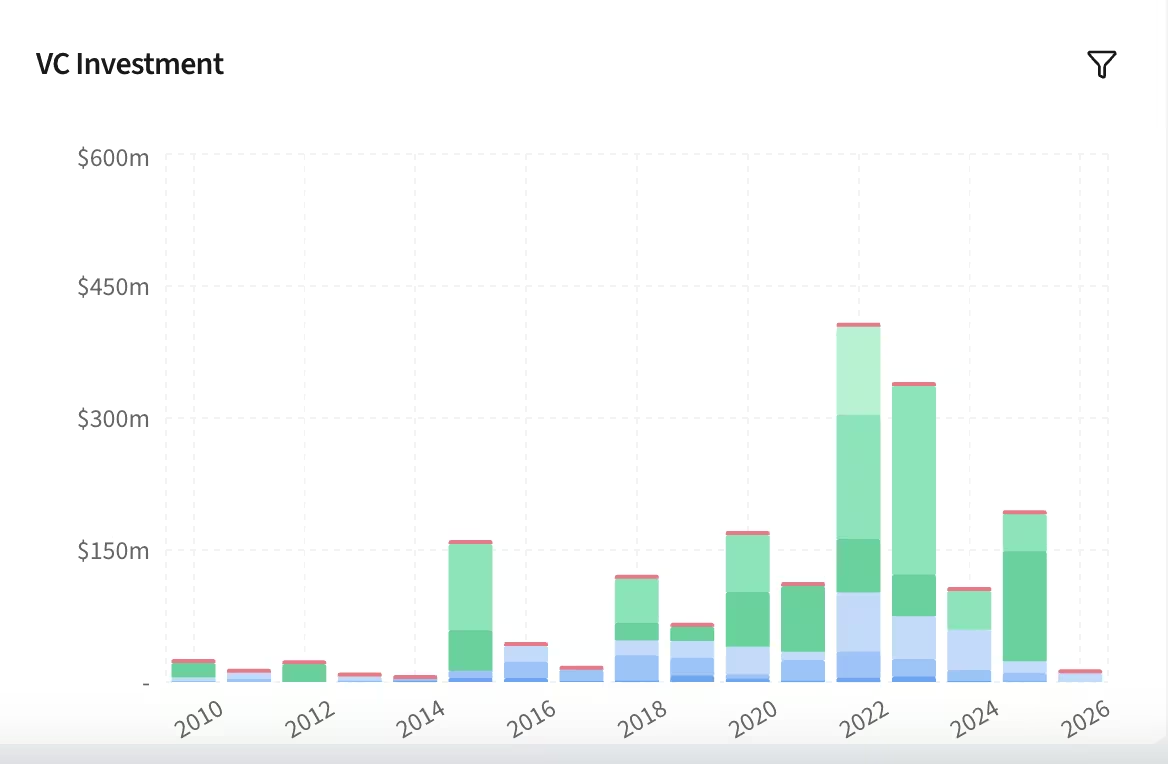
The venture is a fertile addition to Iceland’s growing tech aspirations. In 2025, startups in the country raised a banner €182.4 million in funding, according to Dealroom data - nearly fivefold the €36.1 million bagged in 2024, per a report from the board of Framvís, the Icelandic Angel & Venture Capital Association. Momentum for innovation in the country is strong, and Greipsdóttir says there are ambitious plans to maintain the pace. While the figure of €182.4 million might appear modest in absolute terms, it reveals a staggering intensity when adjusted for the island's population of just over 400,000. This translates to approximately €456 per capita. For context, Germany, Europe’s largest economy, recorded significantly lower venture capital density, with venture capital investment at roughly €100 per capita in 2025 (based on reported funding of ~€8.36 billion for a population of 84 million). This suggests that Iceland’s innovation engine is generating over four times the per-capita investment activity of its continental heavyweight neighbour.
Betting on early-stage startup companies
“We’re an important pillar in Iceland’s ecosystem,” Greipsdóttir noted. “We’re playing the government’s role, in a sense. Since the new fund took over all the assets and liabilities of the previous funds, we have nearly 70 companies in the portfolio, and we are active investors in over 25 of those companies. No less important, the fund is also a shareholder in 5 of the Icelandic VC funds”
The Fund is also authorised to invest in foreign funds. However, a condition for such investment is that it invest at least as much in Iceland. By setting this condition, we hope to draw foreign investors' attention to promising early-stage upstarts based in Iceland.
A strong team is an essential tick box when scouring for nascently-formed startups, she added. “Preferably, we’re investing in mixed-gender teams - and we’re always trying to push for female teams as well.”
It’s vital that founders know what problem their product will solve. The fund looks carefully at a startup’s business plan and how trustworthy their forecasted developments are, Greipsdóttir said.
International ambitions
While Iceland is an insular nation, many of its startups have made a name for themselves across the Atlantic. Digital care startup Sidekick Health has set up shop in the US, while pharmaceutical company deCODE genetics has been a subsidiary of American multinational firm Amgen since 2012.
Part of the impetus behind backing foreign funds is to identify contenders who are “a cultural match for, and have an interest in, Icelandic investments,” Greipsdóttir noted.
“We would welcome foreign investors to come into Iceland,” she said, adding that Iceland welcomes a mixed society because “we are so few that we need more people.”
“It’s been one of the strengths of the ecosystem – but foreign specialists can bring in new culture, knowledge, and more networks – which is what we need. The source of everything is the people building the nation,” she added.
Small but mighty
The size of the Icelandic market can be leveraged as one of its strengths, Greipsdóttir told EWVC. “One of the benefits is that the market is very small, so access to necessary sources can be easy. We can easily access government offices, and within the network of local investors, everybody knows everybody.” That’s handy if “you need proof of trust from a co-investor” because it’s relatively easy to get this information.
The state also plays an important role in aiding the startup ecosystem. A key mechanism is the reimbursement of research and development costs, which Greipsdóttir found to be “the best support implemented for the ecosystem” thus far. Icelandic universities have also been vital to the innovation pipeline. Numerous startups have spun out of the University of Iceland and Reykjavík University, both offering courses in innovation and entrepreneurship.
“In general, there is a strong co-operation within the Icelandic ecosystem. The root is supported by business accelerators such as KLAK and Drift, which help hatch promising early-stage start-ups. The initial financing comes from various grants, and the initial investments can come from Kría Venture Fund and angel investors in Iceban (the Icelandic angel investor network). These first steps are vital, as they create opportunities for the VC funds and smaller investment funds. Without the base funding, there will be a lack of investment opportunities to grow into the future which can harm the country´s competitiveness.”
The New Venture Fund Kria was established through the merger of The Icelandic New Business Venture Fund and Kría fund of funds. The newly-combined fund invests in both early-stage funds, with a focus on Iceland, as well as Icelandic early-stage startups.
Hrönn Greipsdóttir is the CEO of the New Venture Fund Kria. She holds a Cand. Oecon degree in Business Administration from the University of Iceland, and an MBA in Finance from City University, London.