Fueling UK Venture Growth, Interview with Christine Hockley, British Business Bank
%20(3).webp)


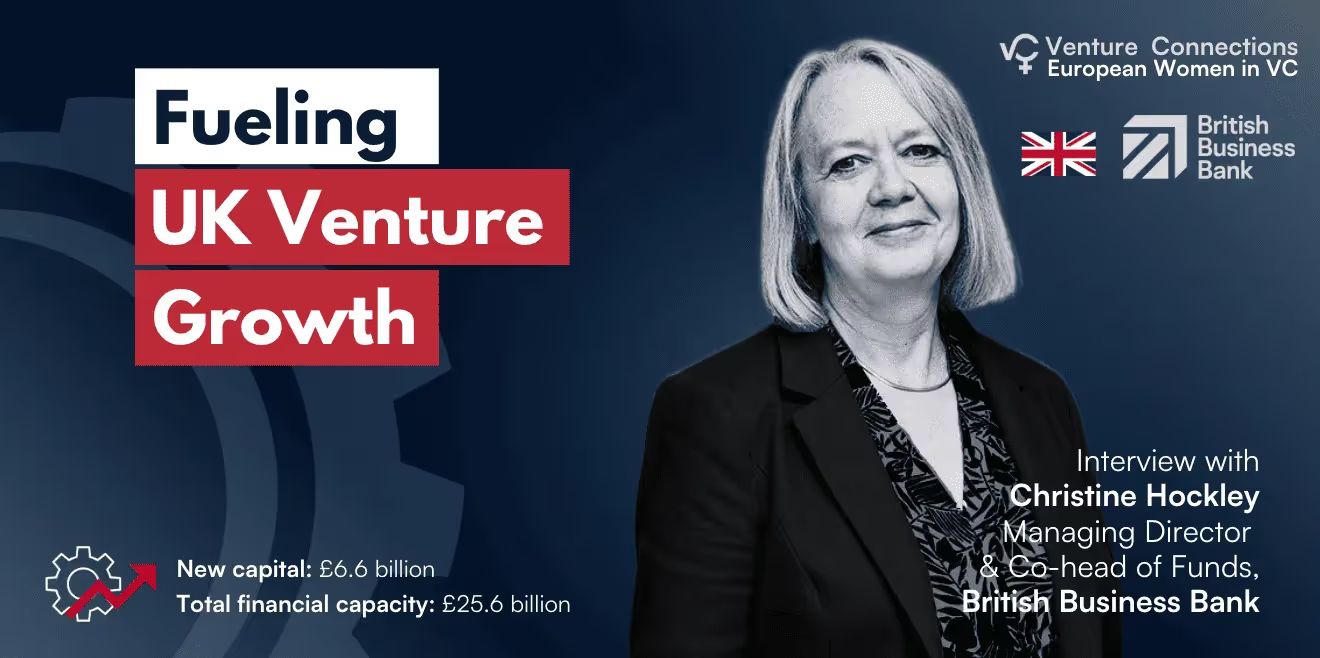
In June this year, the British Business Bank – the UK government’s economic development bank – announced its total financial capacity had been expanded to £25.6 billion.
The institution has sprawled in size and ambition since it was established in 2014. Initially focusing on bolstering SMEs to drive economic development by providing access to capital, the bank has supported over 64,000 small businesses across the UK.
Now, it’s also doubling down on its efforts to galvanise the country’s equity and venture space.
This year, it earmarked a fresh £6.6 billion in new capital for promising investments – and Christine Hockley, managing director and the co-head of funds at the British Business Bank, told European Women in VC that the bank has lofty ambitions to tap into the growth market.
Chasing unicorns
“We’re the largest domestic investor in UK venture,” Hockley said. While the bank allocates patient capital to equity funds in a bid to close the growth gap, it also started directly investing into growth-stage startups at the Series B+ stage a few years ago.
Through its Enterprise Capital Funds programme, the Bank has invested in top-tier funds such as Dawn Capital, Ada Ventures, Concept Ventures, and Notion Capital. It also has a sound track record in backing upstarts; the bank supports nearly 60% of unicorn companies in the UK, including the likes of Quantexa and Synthesia.
Sectors of particular interest include life sciences and deeptech, where the funding gap is especially prevalent at the growth stage, Hockley noted.
“Our investment strategy has evolved, and is evolving, but it entails focusing on investing in innovative, high growth companies, through investing in best of class fund managers with a strong UK focus and a good track record,” she added. “We can be the first big check going in to help catalyse private capital coming in.”
Still, the bank’s role in supporting the venture ecosystem is malleable. “We can play whatever role is required,” Hockley said. “So it might be that a first close, a check is needed to enable that for managers to reach a sensible first close, or it might be at a later stage to reach a size that works for that fund.”
The British Business Bank aims to have a “catalytic effect” – evident in the fact that the funds it has backed through its Patient Capital Funds programme have gone on to raise a further £17.5 billion from third-party investors.
Of the newly minted £6.6 billion, around £4 billion will be channelled into the eight growth sectors of the Government’s Industrial Strategy. This includes everything from “advanced manufacturing, clean energy, creative industries, defense, digital and technology, financial services, and life sciences, to professional business services,” Hockley told EUWVC. “We'll be looking for fund managers that have strategies that will be investing in those pillars.”
The UK touts huge potential
The UK is one of the world’s leading technology markets, trailing behind only the US and China, and the country boasts unparalleled research institutions and universities in the Golden Triangle, including Oxford University and the University of Cambridge.
UK startups secured around $16.5 billion in equity funding last year, a dip from the $19 billion bagged in 2023. Still momentum has been strong in 2025, with startups already clinching $17.3 billion so far – the best funding year since 2022.
So how can it capitalise on these resources to catch up to its transatlantic counterparts?
“If you look at the US, which has a very mature innovation ecosystem, they have a lot of repeat founders,” Hockley said. “The UK is now reaching that stage where we have had more founders that are very successful, and they come back to invest in the ecosystem, or build new businesses.”
Still, Hockley pointed to the lack of institutional capital flowing to startups in the UK as a potential roadblock to the ecosystem’s growth. In the US, 70% of VC capital comes from institutional investors such as pension funds; in the UK, this is a meagre 10%.
While initiatives such as the Mansion House Accords have been set up to tackle this, so that leading pension funds will aim to commit 10% of their defined contributions to the private markets, the BBB has also announced The British Growth Partership to encourage more institutional investors to pump money into the country’s fastest-growing businesses.
Hockley also affirmed the BBB’s support for diverse and emerging fund managers across the UK economy – a strength that the country can continue to take advantage of.

It recently announced a £400 million initiative, Investor Pathways, aimed at making it easier for new entrants, particularly those from underrepresented groups, to break into the capital market. The bank will target diverse decision makers, including female and ethnic minority investors, as well as those with disabilities; the initiative includes micro-investments and a talent fund to help new entrants build a track record and raise funds.
While the UK’s tech ecosystem has long been London-centric, the BBB is working to widen access to capital across the country – so tech talent in the far corners of the UK can be supported and cultivated.
“Our goal is to build out these innovation clusters all around the country,” Hockey said. “And then that builds out capital and the community – which creates the flywheel effect.”
The British Business Bank is the UK government’s economic development bank. Established in November 2014, its mission is to drive economic growth by helping smaller businesses get the finance they need to start, scale and stay in the UK . In doing so, it helps to capture the economic value of innovation for the UK and create jobs and prosperity for people across the country. The British Business Bank’s core programmes support £23bn of finance to almost 64,000 smaller businesses.
Christine is responsible for directing venture capital fund investments in British Business Bank’s venture capital programmes including: the Patient Capital core programme which invests in early and growth stage venture capital funds; the Life Sciences Investment Programme which invests in growth stage life sciences funds; and, the Enterprise Capital Fund Programme which typically invests in emerging managers at the early stage. She has been at British Business Bank for over 10 years primarily investing in venture capital funds and has previous investment, corporate finance and commercial experience.