%20(3).webp)


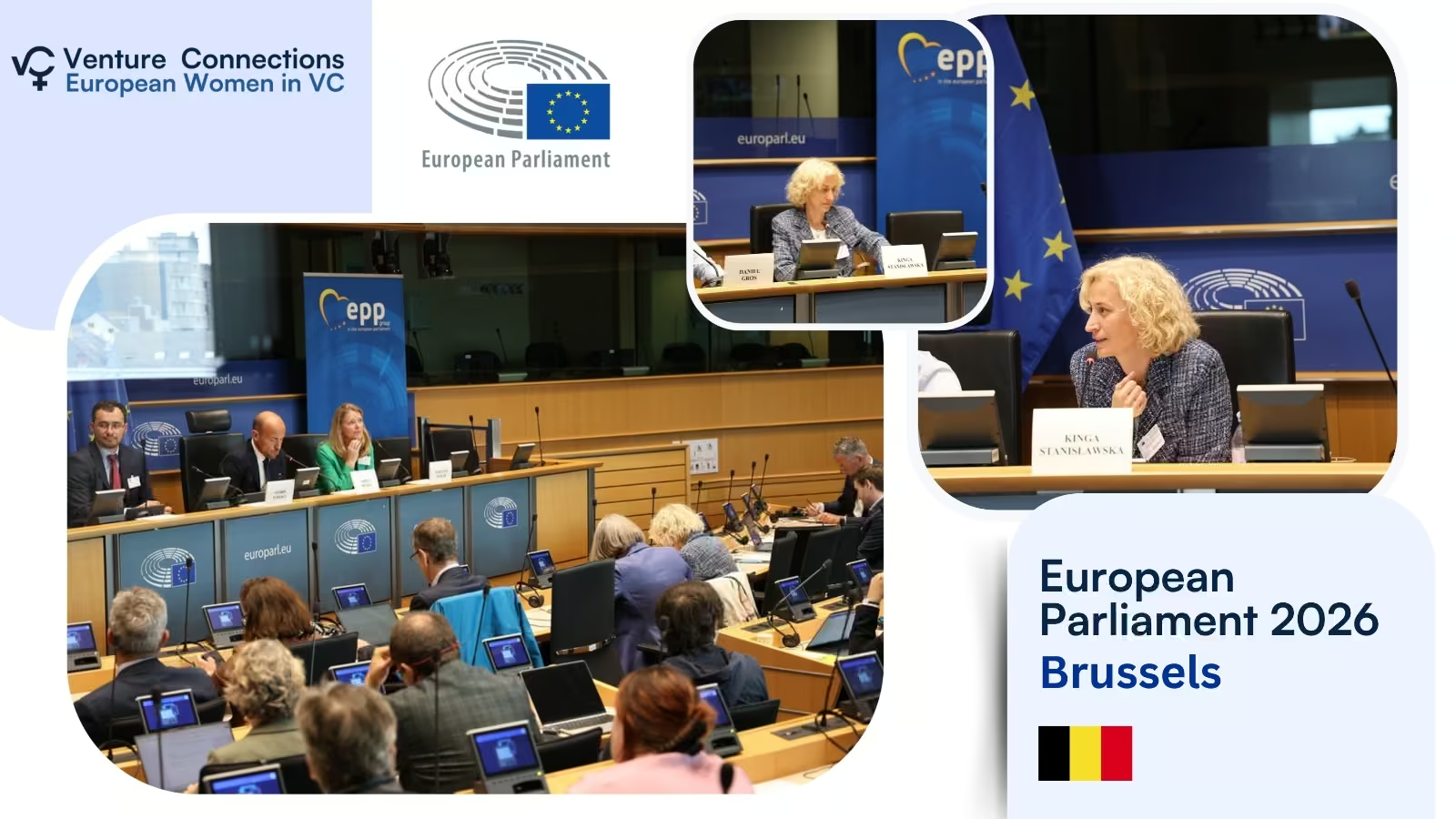
This week, our founder and president, Kinga Stanislawska, took the floor at the European Parliament.
Invited to speak at "Beyond Horizon: Towards a New Era of Integrated European Competitiveness", a Science|Business conference hosted by MEP Borys Budka (Chair, ITRE) and MEP Eva Herczog, Kinga joined a panel alongside Lise Fuhr (CEO, GÉANT) and Daniel Gros of Università Bocconi, moderated by Thomas Brent. With EU Executive Vice President Henna Virkkunen and Marzena Czarnecka in the room, this was exactly the kind of conversation that shapes policy.
1. Europe doesn't have a savings problem. It has a channeling problem.
Mario Draghi was right: the €800 billion investment gap is real. But here's the thing - the money exists. It's just stuck. Fragmented across 27 national markets, locked behind pension fund rules, parked in government bonds when it should be funding the next wave of European innovation.
The Savings & Investments Union is the missing piece of the puzzle. And the message was direct: trilogue cannot be allowed to soften it. Half-measures on capital markets integration don't close an €800 billion gap. They just make it look more tidy.
For us in the VC world, this is personal. Every time a European LP can't deploy into a European growth fund because of a regulatory mismatch, we lose a founder to Silicon Valley. Getting capital flowing isn't abstract policy - it's the oxygen our ecosystem breathes.
2. EU-INC has a structural problem - and Parliament can fix it.
The EU Incorporated concept could move European startups light-years forward. One company form. One set of rules. The simplicity that founders actually need when they're building across borders.
But the March 2026 proposal has a quiet flaw baked in. Article 4, as it stands, doesn't deliver harmonisation - it delivers the illusion of it. By defaulting to the national law of the registered office for every gap in the framework, it effectively turns one European regime into 27. You still have to know which country you're in before you know which rules apply.
Treaty-constrained areas like tax and labour had to compromise. Article 4 didn't - and that's the problem. Parliament holds the fix in trilogue. The choice is straightforward: own the solution, or own the consequences.
3. Widening countries are not an afterthought. They are the proof of concept.
This is the part that matters most to us at EWVC - because it's where the human cost becomes visible.
Poland built a venture capital market largely from scratch. Public capital through the PFR Fund of Funds stepped in to do what pension fund regulation blocked private capital from doing. That's resourceful. That's impressive. And it's also a symptom fix, not a system fix.
Meanwhile, Polish engineers are over-represented at the world's top AI labs - including OpenAI. The country that built decacorn ElevenLabs is watching its talent graduate, and then watching it leave. We train the founders. We train the engineers. Then we export them to ecosystems with better capital architecture. This isn't a talent problem. This is an infrastructure problem. And it has a solution, if the political will is there to build it.
The bottom line
Europe has the science. It has the founders. It has the savers.
What it doesn't yet have is the capital architecture that connects them.
That's the work in front of us - in Brussels, in trilogues, in LP boardrooms, and in every conversation where someone is willing to say the quiet part out loud.